![[Figure 1A]](http://images.squarespace-cdn.com/content/v1/58e61af4a5790ab156e17bc1/04fe6ec5-55ff-401c-bf64-4d2b756ff838/Logo+transparente+background.png?format=1500w)
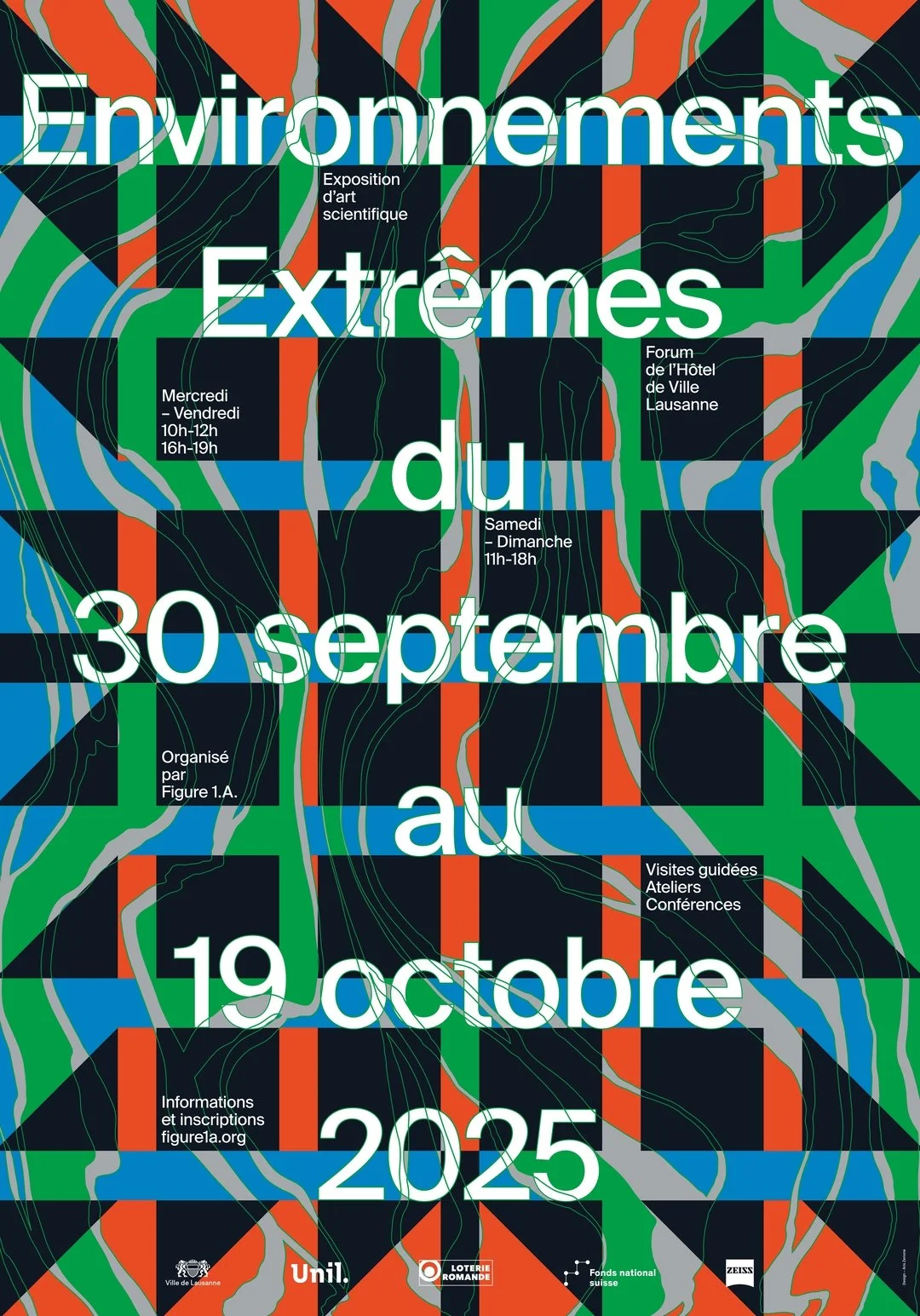
2025 EXHIBITION | Extreme Environments
Extremophiles challenge our perceptions of life’s boundaries, and serve as models for studying climate change impacts because of their capacity to adapt to adverse environments. As Earth’s temperatures rise, will we, humans, need to adapt similarly?
The selection of 24 scientific artworks highlights diversity of interpretations and thoughts on where humanity is right now and where it is headed. What emerges are themes of loneliness and disappointment sprinkled with hope and restorative power of nature. Importantly, many artworks are a fruit of close collaboration between an artist and a scientist — a powerful alliance highlighting the need for empathetic exchange and knowledge sharing between the fields — and one of the aims of Figure1.A. association.
Explore the jury-selected pieces and audience favorites below. Scroll down for more details, including descriptions and information about the artists.
In 2025, we also worked closely with the AlpWISE research group. The resulting Science Corner offered a glimpse into the daily life of researchers working in the Swiss Alps.
Additionally, we collaborated with Azul Pinochet Barros, a talented science writer. In her blog you can read more about the different artworks and discover the many dimensions of extremophile life.
JURY & AUDIENCE AWARDS
JURY AWARD:
Triptych: Mars Analog Site - Río Tinto - Microbial Mats at Río Tinto
Azul Pinochet Barros, The Extreme Philes blog | Spain
The Río Tinto (Tinto River) runs through the Spanish Southern province of Huelva. It is approximately 100 km long, originating in the Sierra Morena mountains of Andalucía and running all the way down to the Gulf of Cádiz. Unlike other rivers, the water that flows here is naturally red due to its high iron and heavy metal content. Its water is also extremely acidic, with a pH ranging between 0 and 3. Despite this, life finds a way. This extreme environment is host to a unique microbial fauna of acidophiles and chemolithotrophs that have evolved remarkable adaptations to thrive in such hostile conditions. In fact, these extremophiles go as far as shaping their environment by contributing to the water’s distinct red color and the formation of beautiful iron terraces, which themselves look like microbial mats.
The extreme, alien-like terrain and unique geology makes Río Tinto a perfect Mars analog site, specifically for the Martian Meridiani Planum. It is thought that the river’s chemical properties could replicate those of subterranean bodies of water on the Red Planet. Understanding how life takes hold in such an extreme environment like Río Tinto can give us hints for the potential for life (past or existant) on Mars as well as clues as to how we could use this knowledge to our advantage here on Earth and for when we eventually set foot on our solar neighbor.
JURY AWARD & AUDIENCE favorite:
Throughout the Eras
Alex Andrix, Independent Artist and Damien de Vienne, evolutionary biologist | Lyon, France
This piece is a representation of evolutionary paths since LUCA, the Last Universal Common Ancestor. The tree shows evolutionary relationships among biological species based upon similarities and differences in their genetic characteristics.
Time passes linearly from LUCA at the center (around 4 billion years ago) to the edges of the disk (present time). Major extinctions known today are displayed as red circles (-445My, -370My, -250My, -201My, -66My). All species represented by a white dot at the edge are still living on Earth because their ancestors adapted to their environment. The majority of all species that ever existed are now extinct.
This artwork was produced by visual artist Alex Andrix and evolutionary biologist Damien de Vienne, author of the Lifemap project (https://lifemap.cnrs.fr/). It was commissioned by the CNRS research institute.
JURY AWARD:
Borrowed Shade & Silent Robber
Fien De Doncker | Lausanne, Switzerland
Borrowed Shade: This visual poem, which combines manual drawing, digital coloring and climate data inspired composition techniques, explores how extreme heat deepens social and spatial inequalities in cities. Through six panels, the comic uses the metaphor of shadow to evoke environmental injustice. The narrative follows a citizen of Lausanne, navigating heat and resistance. This piece speaks to the broader climate crisis: who gets to breathe when the city burns?
The backdrops of some of the panels depict night temperatures in Lausanne in the year 2060, using data from the Modélisation Climatique from the City of Lausanne, which was done in 2024. As urban heat becomes a defining element of extreme environments, this comic interrogates the uneven burden of climate adaptation in cities. It asks how humanity might survive or fracture as temperatures rise beyond historical norms.
Silent Robber: Glaciers are extreme environments in motion, vanishing more rapidly than ever. This data-poem, combining manual drawing, digital coloring and data, in comic form, follows the seasonal life of a glacier as a quiet thief. Personified as a figure that erodes rock and gives his plunder to rivers, the glacier becomes a lens through which we explore time, transformation, and planetary memory.
The text is based on real fieldwork studying erosion rates beneath the Gorner Glacier, and the color palette is based on average sediment provenance maps for the Gornergletscher for the melt seasons of 2019 to 2020. What can we still learn from ice, as it disappears?
JURY AWARD:
Chrysalis
Beric Henderson, Independent Artist | Australia
Beric Henderson is an Australian artist with a background in scientific research (PhD 1990, University of Sydney), and creates artworks that explore the world around us. Since he transitioned from science to full-time art in 2016, he has been fascinated by the extraordinary biodiversity of his local coastal environment. To further explore this with his imagination, he started drawing and painting images of human embryos developing and being nurtured in a nature-enriched womb. This concept is exemplified by the drawing Chrysalis which envisions the symbiotic development of a future human resembling an evolved hybrid, a genetic organism shifted and adapted to a more integrated relationship with the natural environment – whatever state or molecular form that environment may take in the distant future.
Chrysalis is a fanciful and imaginative extrapolation of the idea that in order for humans to better adapt to extreme future environments they will need to significantly change and be better attuned to nature.
JURY AWARD:
Terra forming
Fabien Vialla | Lyon, France
This video artwork seeks to explore the intricate interplay of different scales of space and time through a unique and original medium inspired by science. It is part of a larger exploration of the visual potential of hydrodynamics, the science that studies the behavior of fluids. The selected physical effects in the field of hydrodynamics are chosen for their universality, manifesting in both rapid, microscopic phenomena and slow, large-scale events, extending to global atmospheric and even astronomical occurrences. In this way, the microscope becomes a telescope, bridging the gap between the minuscule and the monumental. Through these parallels between varying scales of space and time, we can investigate how (un)controlled changes in initial conditions can lead to a vast array of (un)predictable and (in)eluctable evolutions, through simple, human scale manipulations. This exploration invites us to reflect on humanity's role and impact within its own environment and future.
This artwork depicts a 7-minutes long and slow evolution of dry lands into vivid waters, passing by what looks like rejuvenating and cataclysmic events, evoking a terra forming solution that is both tempting and burdened. The fluids you can see in the video are simply water, alcohol and oil-based solvents combined with soap. The field depicted, although it can seem wide, is only around one centimeter.
AUDIENCE favorite:
Opalescent Interpretation
Vladimir Pimonov | Lyon, France
Scientific instruments let us push the boundaries of human perception – not just to understand more, but to see differently. Inspired by the idea of synesthesia and the sensory world beyond our own, I asked: can we experience the invisible?
This piece explores that question by treating electron interactions like color. Using a scanning electron microscope, I captured three images of a tiny dust grain, of approximately 20 micrometers in diameter, each under a different electron energy. Then, I merged them into one RGB composition – not to fake color, but to reinterpret it. The result: a fusion of energy and form that gives voice to the silent language of electrons, and a glimpse into what lies just beyond the reach of our eyes.
AUDIENCE favorite:
Les oursins sont dans l’eau chaude !
Richard Germain, Independent Artist | Canada
Here, we see a photo of the skeleton of an Antillean white sea urchin, exhibiting autofluorescence under LED lighting. Spiky and fascinating, sea urchins are silent witnesses to the climatic upheavals affecting our oceans. These echinoderms, essential to the survival of coral reefs and the balance of marine ecosystems, must adapt to increasingly hostile conditions.
In the Caribbean, episodes of torrential rain alter the salinity of the water, affecting the efficiency of the urchins' tube feet and preventing them from anchoring to reefs. Rising temperatures and changing ocean currents are linked to the proliferation of parasites that have decimated entire populations.
The increase in anthropogenic carbon dioxide leads to ocean acidification, weakening their calcium carbonate skeletons and reducing their ability to grow and reproduce. Warmer waters dissolve less oxygen, causing certain species – such as Pacific pink sea urchins – to migrate to shallower waters in search of better-oxygenated zones to survive.
Sea urchins have lived in the oceans for hundreds of millions of years, but their resilience in the face of these challenges raises questions about our own ability to adapt. Their struggle for survival reminds us that, in this new reality, evolution is a race against time. As extreme climatic events reshape the living world, will we be able to reinvent ourselves?

This work is licensed under a Creative Commons Attribution-NonCommercial-NoDerivatives 4.0 International License.